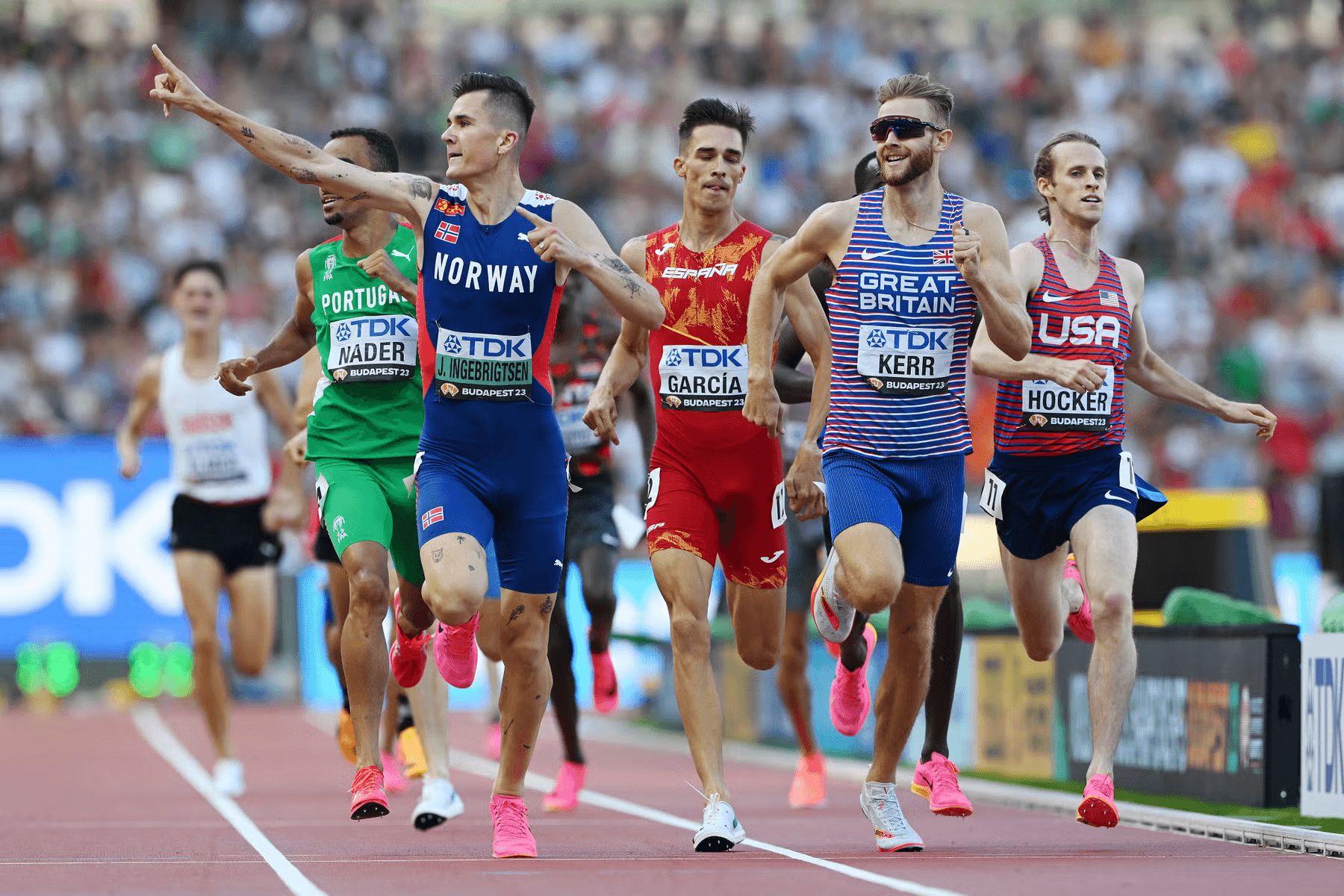
How Jakob Ingebrigtsen trains differently
Jakob Ingebrigtsen is easy to turn into a training myth.
He has Olympic golds at 1500m and 5000m, world titles over 5000m, and world records or world bests across several middle-distance events. He races like a 1500m runner with a huge aerobic engine, but also like a 5000m runner who refuses to give away finishing speed.
So the internet does what the internet does. It looks for the secret.
Double threshold. Lactate testing. Huge mileage. Hills. Treadmills. Altitude. Strength work. A famous training family. A very Norwegian willingness to make intensity boring.
All of those details matter. But if you reduce Jakob's training to any one of them, you miss the point. The most interesting thing about the Ingebrigtsen system is not that it is extreme. Plenty of elite training is extreme. The interesting thing is how much of the work appears designed to avoid unnecessary extremity.
Jakob does not seem to train differently because every session is heroic. He trains differently because so much of the system is built around controlling the dose, repeating the dose, and protecting the next dose.
That is the useful lesson for serious runners.
The visible structure
The public version of the Ingebrigtsen training model is now fairly well known, although not every detail is public and not every season looks the same.
The broad pattern described in research and coaching sources is roughly this: high overall volume, a lot of low-intensity running, frequent threshold-oriented interval work, lactate monitoring to keep intensity in range, and limited truly anaerobic work outside specific speed or race-preparation sessions.
In one published review of Norwegian distance-running training, the Ingebrigtsen brothers' preparation period was described as averaging around 150-160 kilometres per week during a 13-14 week block in 2018-2019. The same review describes threshold work four times per week, organised as two double-threshold days, with limited work in the more anaerobic zones.
That does not mean every runner should write down 160km, two double-threshold days, and a hard Saturday session.
It means the visible structure sits on top of a much bigger foundation: years of progressive development, a high tolerance for volume, careful intensity control, and a life organised around training.
Without that foundation, the same schedule is not the same training.
The difference is not more intensity
The lazy interpretation is that Jakob is successful because he does more hard workouts than everyone else.
That is not quite right.
A better interpretation is that he does a lot of fast-enough work without making too much of it too hard. Threshold intervals let an athlete accumulate quality at speeds that are meaningful for performance while keeping the metabolic cost lower than race-pace hammering. Splitting that work into two sessions on a day can increase the total amount of useful work while reducing the chance that one massive session becomes sloppy, anaerobic, and destructive.
This is the opposite of how many ambitious recreational runners behave.
They under-build the easy volume, then try to make the workout carry the whole week. The tempo becomes a race. The interval session becomes proof of fitness. The long run becomes a progression whether or not the body is ready for it. The athlete gets a big stimulus, but not always a repeatable one.
Jakob's model is interesting because it treats repeatability as the point.
A session is not just judged by whether it was impressive. It is judged by whether it fits inside the week, whether it preserves the next session, and whether it contributes to a larger load the athlete can absorb.
That is a very different mindset from chasing the hardest possible workout.
Lactate testing is a control tool, not a personality trait
Blood lactate testing gets a lot of attention because it is visible and slightly exotic. It also makes the training sound more scientific than a normal runner's pace chart.
But the meter is not the secret. The control is the secret.
Lactate testing is useful because it gives the athlete an internal marker. Instead of assuming the right pace from a watch, the runner can check whether the body is actually responding as intended. If lactate is climbing too high, the session can be adjusted before it becomes a different workout.
That matters because threshold work lives in a narrow behavioural space. Too easy, and the stimulus may be smaller than intended. Too hard, and recovery cost rises quickly. The meter helps police that boundary.
For normal experienced runners, the exact tool may be less important than the honesty it enforces.
You can approximate the same principle with repeatable routes, heart rate trends, breathing, controlled pace ranges, and a simple question after the session: could I do useful training again soon?
If the answer is no, the workout may have been satisfying. It may not have been well controlled.
He is a 1500m runner built on distance-runner logic
Jakob's range is part of what makes him unusual. He can run brutally fast over 1500m, but his 5000m strength is not a side project. His results suggest an athlete whose middle-distance speed is supported by a large aerobic base rather than separated from it.
That matters for how runners interpret the training.
Some 1500m training systems lean heavily into speed, power, and high-intensity work. The Ingebrigtsen approach appears more aerobic in its bias: build a huge amount of controlled endurance work, touch faster running in specific doses, and use speed without letting it dominate the training week.
This is why copying one session from the system can be misleading.
A fast set of short reps is not floating in isolation. It is supported by easy volume, threshold density, strength, recovery, and years of adaptation. The workout looks like the exciting part, but the boring surrounding work is what makes it usable.
That is usually the piece runners skip.
What runners misunderstand
The biggest misunderstanding is thinking the system is a collection of workouts.
It is better understood as a load-management system.
The double-threshold days are not magic because two sessions are automatically better than one. They are useful when splitting the work lets a highly trained athlete accumulate more threshold load with less damage than cramming it into one session.
The lactate meter is not magic because blood values are inherently superior to judgment. It is useful because it prevents ego from moving the session outside the intended intensity.
The high mileage is not magic because more distance always works. It is useful because, when absorbed, it supports a bigger aerobic engine and makes the quality work more stable.
The system is impressive because the pieces reinforce each other.
If you remove the volume, the double days make less sense. If you remove the intensity control, the threshold work becomes too costly. If you remove the recovery context, the density becomes dangerous. If you remove the athlete's long development history, the weekly structure becomes cosplay.
What experienced runners can borrow
The best thing to borrow from Jakob is not his week. It is his restraint.
That sounds strange because elite training looks anything but restrained. But inside the system, restraint is everywhere: controlled threshold instead of racing, limited anaerobic work during base periods, easy running that supports rather than competes with quality, and a bias toward repeatable training load.
A serious recreational runner can borrow that immediately.
Start with these questions:
Is my easy running actually easy enough to support the week?
Are my threshold sessions controlled, or do they drift into racing?
Am I adding intensity because I need it, or because the week feels too boring?
Do my workouts make the next good session more likely or less likely?
Is my training load progressing, or am I just collecting impressive individual sessions?
For many runners, the best Jakob-inspired change would be a less dramatic workout.
Run the tempo slightly easier. Break it into intervals. Keep the last rep looking like the first. Add easy volume only if you can absorb it. Treat the week as the unit, not the single session.
That is less glamorous than saying you train like Jakob.
It is also much closer to the actual lesson.
What not to copy blindly
Do not copy the mileage unless your body has earned it.
Do not copy double-threshold days unless a single controlled threshold session is already routine and recoverable.
Do not copy lactate numbers as universal truth. Lactate response varies, and public examples are context-dependent. A value that makes sense for one athlete, session, and phase may not be a rule for you.
Do not copy the density without copying the recovery environment. Elite athletes are not just doing more training. They often have more time, more monitoring, more support, and fewer non-training demands than normal runners.
And do not assume the public version is the full version. Training details are filtered through interviews, research summaries, social media, and observation. We know enough to discuss the principles. We do not know every adjustment, every injury-management decision, or every private tradeoff.
That uncertainty should make the lesson more practical, not less.
The kaizen takeaway
The useful lesson from Jakob Ingebrigtsen is not that every runner needs a Norwegian training system.
It is that performance comes from accumulating a large enough body of well-absorbed work, with enough control that the athlete can keep coming back. The details are interesting because they are one sophisticated answer to that problem.
kaizen is built around the same bigger question.
Not: did you complete the magic workout?
But: what training load are you accumulating, what fitness does it suggest, and what weekly target moves you toward your goal without pretending real life does not exist?
Different systems can work. Threshold-heavy systems, more polarized systems, marathon-specific systems, and simpler recreational plans can all be useful if they help the runner build enough load consistently and recover from it.
Jakob's training is worth studying because it makes one thing very clear: the best athletes are not just fitter because they suffer more. They are fitter because they have found ways to make high-value work repeatable.
That is the part worth stealing.


