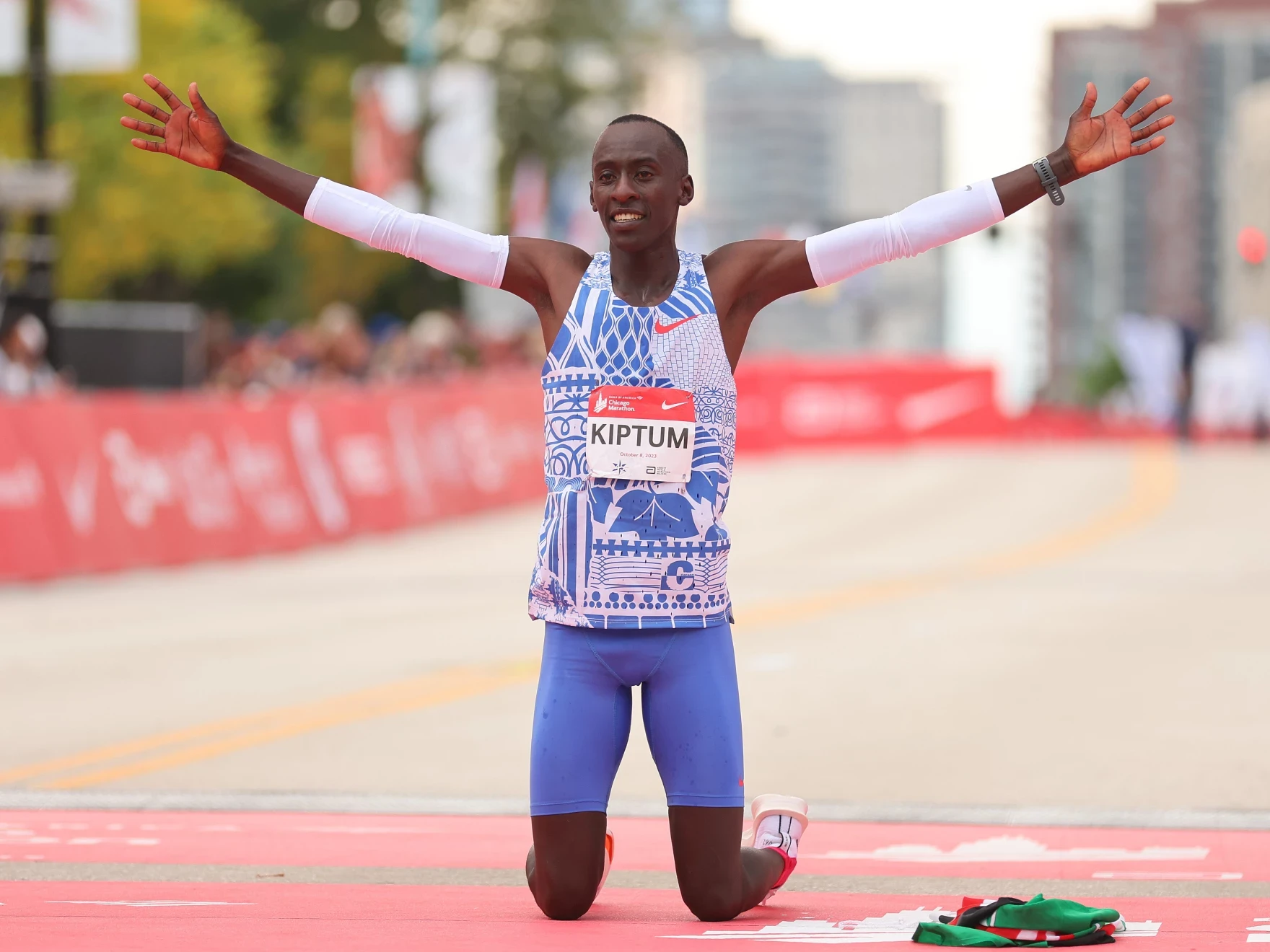
What Kiptum's Chicago block really teaches runners
Kelvin Kiptum’s 2023 Chicago Marathon is one of those performances that makes runners lose their sense of proportion.
The time was absurd: 2:00:35. The way he ran it was almost more absurd. He did not just hang on. He accelerated. World Athletics reported that he became the first man to break 2:01 in a record-eligible marathon, taking 34 seconds off the previous world record.
Then the training details started circulating.
Huge mileage. Three-run days. Long runs that would be peak weeks for normal runners. Reports of 250-300km per week, sometimes more. Suddenly, the internet had its favourite kind of training story: an elite athlete doing something so extreme that everyone could stare at it, screenshot it, argue about it, and secretly wonder whether they should be doing a slightly less insane version of the same thing.
But that is the wrong lesson.
The point of Kiptum’s block is not that marathon runners should run 300km per week. Almost nobody should. The useful lesson is simpler and more uncomfortable: the best marathoners are not made by one clever session. They are made by the amount of specific training load they can accumulate, absorb, and repeat.
What we actually know
The race outcome is clear. Kiptum won Chicago on 8 October 2023 in 2:00:35, a performance later ratified by World Athletics as a world record. He was 23 years old, and it was only his third marathon after Valencia 2022 and London 2023.
The training details are less clean, but still useful. Kiptum’s coach, Gervais Hakizimana, described very high-volume preparation to AFP, with coverage relayed by LetsRun. The broad picture was that Kiptum often trained in the 250-300km-per-week range, with some weeks reportedly going beyond 300km before London, and a structure built around enormous volume plus hard long efforts.
We should be careful here. We do not have a clean, complete, day-by-day Chicago build from Kiptum’s own training log. The exact sessions are less certain than the headline volume. So the honest version is not: “Here is precisely what Kiptum did.”
It is: “The credible reporting points to a block defined by exceptionally high load, frequent running, and hard marathon-specific work.”
That distinction matters.
The obvious lesson is the least useful one
The obvious takeaway is: Kiptum ran huge mileage, therefore huge mileage is the secret.
That is true in one sense and useless in another.
Yes, the volume matters. You do not run 2:00:35 off a clever Tuesday workout and a motivational quote. Marathon performance is brutally tied to aerobic development, muscular durability, fuel use, fatigue resistance, and the ability to keep producing force when the race has stopped feeling like running and started feeling like negotiation.
All of that is built through load.
But mileage is not magic. Mileage is just the visible wrapper around stress. Two runners can both run 100km in a week and get very different training effects depending on pace, terrain, long-run structure, workout density, fatigue, heat, sleep, and how prepared they were for that week in the first place.
Kiptum’s mileage was remarkable because he could apparently absorb it. That is the part most runners skip.
They look at the number and miss the adaptation.
The real signal: load plus durability
The defining feature of Kiptum’s training was not just that it was big. It was that the bigness appeared to be functional.
That is a different thing.
Any runner can force a bigger week if they are reckless enough. You can always add another easy run, stretch the long run, turn a steady day into a progression, or convince yourself that fatigue is just weakness leaving the body. For a week or two, the spreadsheet looks impressive.
Then the body sends the invoice.
Useful training load is not the work you can survive once. It is the work you can absorb often enough for it to change you.
That is why elite marathon training can look so alien. The visible sessions are not floating in space. They sit on top of years of tissue tolerance, aerobic development, daily routine, recovery capacity, and a life organised around training. The hard long run is not the whole story. The story is the body that can recover from it and train again.
This is where runners get elite training backwards. They copy the sharp end of the system before they have built the base that makes the sharp end useful.
What Kiptum's block says about modern marathon training
Modern marathon training is increasingly specific, but “specific” does not mean doing marathon-pace hero workouts all year.
It means building toward the ability to handle race-relevant stress: long sustained efforts, high weekly volume, controlled intensity, and enough durability that the final 10km is not a complete structural failure.
Kiptum’s Chicago performance was famous for the late-race acceleration, but that acceleration was probably not created by a magical late-race workout. It was the expression of a massive underlying training history. The race made the training visible.
That is the useful frame for experienced runners.
Do not ask: “What was his best session?”
Ask:
What load was he able to tolerate?
How much of that load was specific to marathon demands?
How often could he repeat it without breaking down?
What did the surrounding easy work allow the hard work to become?
What would the equivalent stimulus look like for someone with a normal life and normal durability?
The last question is the only one that matters for most runners.
What you can borrow
You cannot borrow Kiptum’s mileage. You can borrow the principle.
1. Build the week, not the workout
A single session is rarely the point. The week is the unit that actually shapes fitness.
If you do one huge long run and spend the next six days compromised, that is not a breakthrough. It is just poor accounting. Kiptum’s training is a reminder that performance comes from the total load you can accumulate across weeks and months, not from one session that looks impressive on Strava.
2. Specificity has to be earned
Marathon-specific work is powerful when the body is ready for it. It is expensive when it is not.
Before copying long hard runs, the better question is whether your current training can support them. Do you have enough easy volume? Are you recovering between quality days? Is your long run already stable? Are you progressing gradually, or just importing someone else’s peak block into your normal week?
Specificity works best when it is layered onto capacity.
3. More is better only when it is absorbed
The contrarian take is that runners are both right and wrong to obsess over mileage.
They are right because load matters. A lot. There is no serious version of marathon improvement that ignores the amount of training you are doing.
They are wrong when they treat mileage as a trophy rather than a stimulus. The goal is not to run more for the sake of saying you ran more. The goal is to apply enough load to improve, while keeping the body healthy enough to keep applying it.
What you should not copy
Do not copy the 250-300km weeks.
Do not copy the frequency unless your life and body can support it.
Do not copy the hard long runs without copying the years of preparation underneath them.
And definitely do not turn Kiptum’s training into a moral lesson where “serious runners do more” and everyone else is just soft. That is not analysis. That is internet machismo with a training log attached.
The serious lesson is more precise: improvement comes from increasing the load you can handle. The ceiling matters, but so does the rate of increase. Ambition without durability is just a delayed setback.
The kaizen takeaway
This is exactly why kaizen is built around training load rather than worshipping one plan, one system, or one heroic session.
Kiptum’s training is fascinating because the details are extreme. But the principle underneath is relevant to every runner: your fitness is shaped by the load you accumulate, how consistently you accumulate it, and whether your body can absorb it.
You do not need to train like Kelvin Kiptum. You need to know what your current training is pointing toward, what load is realistic for your goal, and how to build toward it without pretending real life does not exist.
That is the useful version of inspiration. Not “copy the elite.”
More like: understand the mechanism, then scale it honestly.
If you want to get fitter, the question is not which famous block you can imitate. It is what training load you can build from where you are now — and how to keep nudging that number upward for long enough that your body actually changes.
That is less glamorous than a 300km week.
It is also much more likely to work.


