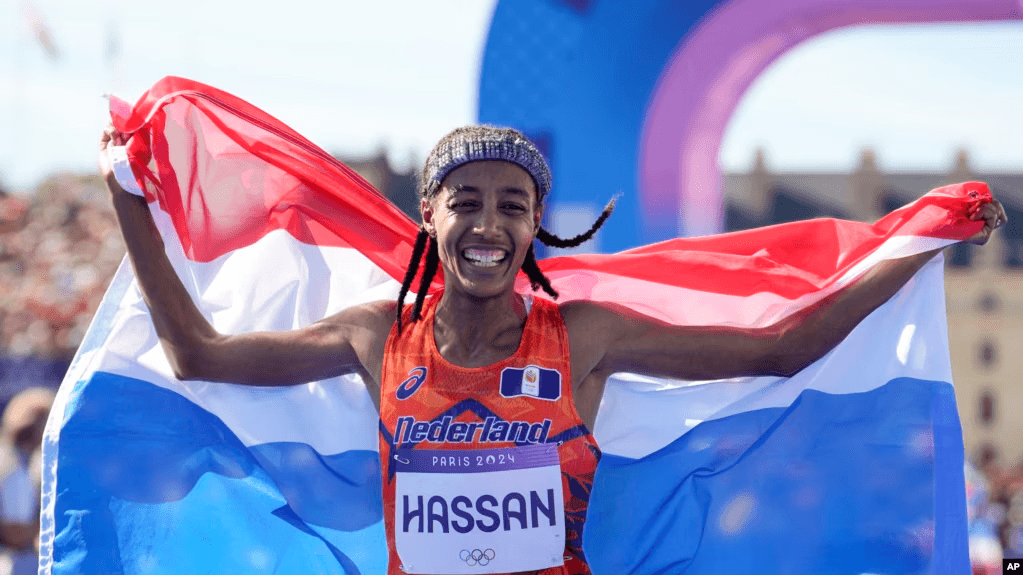
Sifan Hassan's marathon range is the lesson
The useful lesson
Sifan Hassan's marathon success is not interesting because it reveals a neat marathon formula. It is interesting because it refuses to fit one. From world-class 1500m speed to Olympic marathon gold, her career shows that the marathon rewards more than one athletic profile. The lesson for serious runners is not to copy her range. It is to build the kind of durable, well-absorbed fitness that can express itself in different ways.
Key takeaways
Hassan won her marathon debut at the 2023 London Marathon in 2:18:33.
She then ran 2:13:44 at the 2023 Chicago Marathon, a European record and one of the fastest marathon performances in history.
At Paris 2024, she won Olympic marathon gold in 2:22:55 after bronze medals in the 5000m and 10,000m at the same Games.
Her marathon range is built on years of elite middle-distance and long-distance development, not a sudden marathon hack.
Normal runners should copy the principle: keep enough speed, build enough aerobic depth, and manage load so the body can absorb it.
Why Sifan Hassan is such a strange marathon case
Most marathon stories are told as a move up in distance. Hassan's story is messier and more useful.
She is not just a former track athlete who moved to the marathon. She has won global titles on the track, medalled across 1500m, 5000m and 10,000m at Olympic level, and then still became one of the best marathoners in the world. In Paris, the range became almost absurd: 5000m bronze, 10,000m bronze, then marathon gold in an Olympic record.
That does not mean the marathon is secretly a speed event. It means Hassan arrived with an unusual combination: speed, aerobic depth, race nerve, and durability.
For recreational runners, the point is that marathon fitness is not one narrow thing. It is a wide system of capacities that have to be built and protected.
What her marathon results actually show
Hassan's marathon record is still short compared with career specialists, but it is already unusually broad.
Race | Result | Why it matters |
|---|---|---|
2023 London Marathon | 1st, 2:18:33 | Won on debut against a deep field |
2023 Chicago Marathon | 1st, 2:13:44 | European record; historically fast performance |
2024 Tokyo Marathon | 4th, 2:18:05 | Fast but not unbeatable; useful reminder of race context |
Paris 2024 Olympic Marathon | 1st, 2:22:55 | Olympic record after 5000m and 10,000m medals |
2025 London Marathon | 3rd, 2:18:59 | Still competitive in a major after Olympic gold |
2025 Sydney Marathon | 1st, 2:18:22 | Course record in Sydney's major-era debut |
The pattern is not perfection. It is range.
She can win a tactical championship marathon, run a brutally fast city marathon, lose and still run 2:18, and carry track and marathon racing inside the same year.
The better question is: "What capacities let an athlete remain dangerous across so many contexts?"
The real lesson is range, not randomness
Range can look chaotic from the outside. But treating Hassan as if she simply ignores normal constraints misses the training principle.
Elite range is not the absence of structure. It is the result of a body progressively prepared to tolerate different stresses. Speed helps her finish. Endurance keeps her there. Durability lets the training be absorbed.
For a marathoner, range means having more than one way to solve the race.
A runner with range can:
handle steady aerobic volume without breaking down
touch faster paces often enough that marathon pace does not feel sharp
recover from hard sessions without losing the week
race well when the course, weather or pacing is imperfect
adapt the plan when life interrupts the ideal version
That is a more useful model than chasing one signature workout.
What runners should copy from Hassan's marathon range
You cannot copy Hassan's genetics, history or training environment. You can copy the idea that marathon performance is more robust when it is supported by multiple capacities.
Hassan-style capacity | Normal-runner version |
|---|---|
Elite track speed | Strides, short controlled reps, and relaxed faster running |
Massive aerobic depth | Consistent weekly volume that increases gradually |
Championship race patience | Learning not to panic when pacing is uneven |
Marathon-specific durability | Long runs and medium-long runs you can recover from |
Adaptability across events | A plan that can reroute without collapsing after missed runs |
The important word is controlled.
Speed work should make marathoners more economical, not turn the week into a track meet. Long runs should build durability, not create recovery debt. Bigger training only helps if it leaves you able to keep training.
Hassan's career is spectacular, but the practical message is quite conservative: develop capacities over time, then protect the continuity that lets them compound.
What not to copy
Do not use Hassan as permission to overload every direction at once.
Her range is exceptional because most athletes cannot safely combine that many demands. A runner who adds more mileage, harder workouts, more racing, and longer long runs at once is usually just increasing noise.
Do not assume shorter-distance talent automatically predicts marathon success either. The marathon still asks specific questions: fueling, durability, muscle damage, pacing discipline, and the ability to keep moving when the race stops feeling athletic. Hassan answers those questions unusually well. That does not make them optional.
How to build useful range in your own training
For experienced runners, the safe version is not complicated.
Keep one small speed touch most weeks. Strides, short hills or relaxed reps can preserve coordination without dominating the plan.
Build aerobic load gradually. The boring accumulation is still the main engine of marathon improvement.
Use long runs as durability work. Add progression, steady sections or marathon-pace blocks only when the base supports it.
Separate stress when possible. If the long run grows, the workout may need to become more controlled. If life stress rises, training stress may need to come down.
Judge the week by absorption. A week is not successful because it looked impressive. It is successful if it moves you forward and leaves you able to continue.
This is where Hassan's example becomes relevant: not in the details, but in the shape of the problem.
The marathon is not only about distance. It is about how training stresses add up, how much your body absorbs, and whether the plan adapts before the cost gets too high.
What we know, and what we're inferring
The race facts are clear: Hassan's marathon debut win in London, her 2:13:44 in Chicago, her Paris 2024 Olympic marathon gold, and her later major results are all publicly reported. Her wider track range is also well documented.
What we do not have is a complete private training diary. So the training claim here is interpretive: Hassan's results are best read as evidence of unusually broad capacity, not as proof of one secret marathon method.
The kaizen takeaway
Sifan Hassan's marathon range is a reminder that performance comes from the whole training picture, not from one perfect session or one fixed identity as a runner.
kaizen is built around that same bigger picture. It estimates current fitness, sets weekly training-load targets, and adjusts when the week changes, so you can build the kind of durable progress that actually survives real life.
You do not need Hassan's range.
You need enough range for your goal: the speed to stay efficient, the aerobic load to get stronger, and the consistency to keep absorbing the work.


