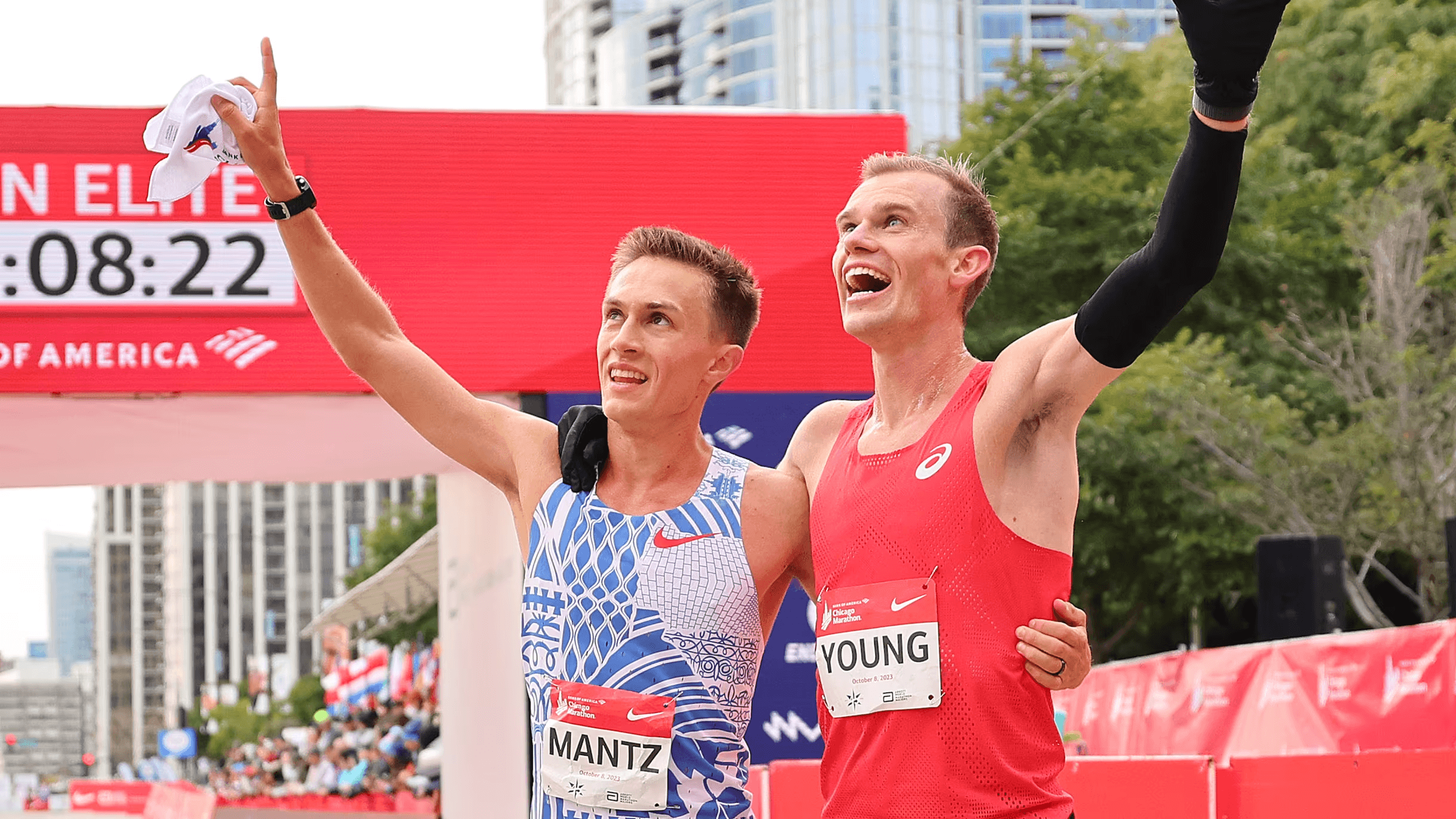
What BYU marathoners do differently
The useful lesson
BYU's recent marathon success is not built around one exotic workout. The more useful pattern is a stable system: strong aerobic volume, altitude exposure, consistent training partners, patient coaching, and race preparation that keeps athletes durable enough to compete well late. Conner Mantz and Clayton Young make the story visible, but the lesson for serious runners is broader: the environment around the training can matter as much as the session written on the calendar.
Key takeaways
Conner Mantz and Clayton Young went 1-2 at the 2024 U.S. Olympic Marathon Trials in Orlando, running 2:09:05 and 2:09:06.
They later finished eighth and ninth at the Paris 2024 Olympic Marathon, again showing how useful a shared preparation environment can be.
Mantz has since raised the ceiling again: he ran 2:04:43 at the 2025 Chicago Marathon, breaking the official U.S. men's marathon record.
Boston 2026 also underlined the broader U.S. depth story, although Boston's point-to-point course is not record-eligible in the same way.
Both came through BYU and continued to work with Ed Eyestone, a two-time Olympic marathoner and long-time BYU coach.
The standout feature is not a secret workout; it is continuity, training partners, altitude, strength, and repeatable marathon-specific work.
Normal runners should copy the system logic, not the elite workload.
Why BYU has become a marathon story
BYU is usually discussed as a college distance-running power. That is fair: the men's cross-country program has won NCAA titles under Ed Eyestone, and athletes such as Mantz and Young built much of their development in Provo.
But the marathon story became impossible to ignore after 2023 and 2024. At the 2023 Chicago Marathon, Mantz finished sixth in 2:07:47 and Young seventh in 2:08:00, both inside the Olympic qualifying standard. At the 2024 U.S. Olympic Marathon Trials, they controlled the decisive part of the men's race and finished first and second. In Paris, on a demanding Olympic course, they placed eighth and ninth.
The story has moved on since then. Mantz is now the official U.S. men's marathon record holder after running 2:04:43 at the 2025 Chicago Marathon. That matters for this article because the BYU-linked system is no longer just a nice Olympic Trials narrative. It has now produced the fastest record-eligible marathon ever run by an American man.
Those results do not prove that every runner should train like BYU's best marathoners. They do show that something in the setup is working: the athletes arrive prepared, race together well, and keep translating strong collegiate distance backgrounds into marathon performance.
The BYU difference is the whole training environment
The lazy version of this article would be a list of workouts. That would also be the least useful version.
From public reporting, the BYU-linked marathon setup has several visible ingredients: high-level training partners in Provo, coaching continuity with Eyestone, altitude-based daily training, weight-room and mobility work, and enough marathon-specific volume to make 26.2 miles feel like an extension of the system rather than a one-off stunt.
The harder thing to copy is the social structure. Mantz and Young do not just occasionally share a session. They have been described as training partners who spend large parts of the day together: workouts, lifting, recovery routines, and heat preparation. That matters because marathon training is psychologically expensive. A good partner can make high standards feel normal without turning every session into a race.
For experienced runners, that may be the most transferable idea. Training improves when the default environment nudges you toward consistency.
What to copy, and what to leave alone
BYU-linked feature | What it means for elites | Normal-runner version |
|---|---|---|
Strong training partners | Daily accountability and shared race preparation | One or two reliable partners for key runs |
Altitude in Provo | Aerobic stimulus layered into normal training | Do not chase altitude; build consistent volume first |
Coaching continuity | Fewer random changes between cycles | Keep the same principles long enough to adapt |
Strength and mobility | Supports high mileage and durability | Small, repeatable strength work 2-3 times weekly |
Marathon-specific long runs | Practice for fatigue, rhythm, fueling, and pace | Long runs you can recover from, not heroic tests |
Shared racing goals | Partners can rehearse tactics together | Use tune-ups and workouts to practise decision-making |
The warning is obvious but worth saying: the elite version is not the prescription. Mantz and Young are professional marathoners with years of high-level development. A normal runner copying only the mileage or the long-run structure is copying the cost without the support system.
The training principle is continuity under pressure
The marathon exposes whether training has been durable. It is hard to fake the last 10K.
That is why the BYU example is interesting. The visible pattern is not athletes peaking once and disappearing. It is repeated strong racing across Chicago, the Trials, Paris, the 2025 Boston build-up, and Mantz's U.S.-record run at Chicago in 2025. Mantz and Young also have different personalities and approaches: public reporting has described Young as more data-oriented and Mantz as more feel-driven and aggressive. Yet the same ecosystem has worked for both.
That should make runners less obsessed with finding one perfect personality type or one perfect workout. A good system can hold different athletes if the broad ingredients are right: enough work, enough recovery, enough specificity, enough feedback, and enough trust to keep going when the block gets uncomfortable.
For marathoners, continuity is not just avoiding injury. It is avoiding constant plan-switching. It is repeating the boring parts of preparation until they become reliable.
How experienced runners can apply it
You do not need to move to Provo or find an Olympic training partner. You need to make your own setup more repeatable.
Choose stable training principles for a full cycle. Do not rebuild the plan every time you read about a new system.
Find accountability for the sessions that matter. A partner, coach, club, or recurring group run can make consistency less dependent on motivation.
Keep strength work boring enough to repeat. The useful version is the one you actually do when mileage rises.
Use long runs to practise rhythm. Marathon training is not only about surviving distance; it is about learning how effort should feel late.
Separate confidence from recklessness. If a workout proves fitness but damages the next week, it was too expensive.
Measure the whole week, not the highlight session. Marathon progress usually comes from the accumulated pattern.
This is where many serious runners go wrong. They study elite systems for novelty, when the real advantage is usually stability. The BYU-linked marathoners look different because their training world makes the right behaviours repeatable.
What we know, and what we're inferring
The race facts are clear: Mantz and Young ran 2:07:47 and 2:08:00 at Chicago 2023, finished 1-2 at the 2024 U.S. Olympic Marathon Trials, and placed eighth and ninth in the Paris 2024 Olympic Marathon. Mantz then ran 2:04:43 at the 2025 Chicago Marathon, breaking the official U.S. men's marathon record. Public reporting also supports the broad picture of their partnership in Provo under Ed Eyestone.
What we do not have is a complete private training diary for every block. The training interpretation here is therefore cautious: BYU's marathon success appears to come from a durable ecosystem rather than a single secret session.
The kaizen takeaway
The best lesson from BYU's marathoners is that good training is easier to repeat when the system around you supports it. Partners, routine, coaching principles, strength work, and weekly structure all reduce the friction of doing enough of the right work.
kaizen is built for that same problem at the individual level. It estimates current fitness, sets weekly training-load targets, and reroutes the week when life changes, so the plan can stay coherent instead of collapsing after one missed run.
You do not need an elite group. You need a training environment that helps you keep stacking useful weeks.
Related reading: Conner Mantz and the specificity trap.


